

When the System Breaks the Worker
The problem on everyone's mind: WORK

The Burnout Calendar
On Garrett Carlson’s first day of teacher onboarding, before he ever stepped foot in a classroom, the county showed all the new teachers a chart. A calendar, actually, plotting month by month the emotional trajectory of a first-year teacher: September—excited! October—still excited! November—done. December—even worse. January, after winter break—excited again! February—just waiting for spring break.
“That’s how they introduce you to the field,” Garrett explains on the Unhustle podcast. “That’s the first thing before you even get into a classroom. They tell you that you’re probably going to be burnt out.”
The administrators knew what was coming. The veteran teachers knew. The statistics backed it up: most teachers who leave the field do so within their first five years. Everyone in that room understood that the system would grind these eager young educators down, predictably and systematically, until they either hardened into cynicism or quit entirely.
And nobody thought to change the system itself.
Garrett lasted six years—longer than most—because he genuinely loved teaching. After three years, he landed what seemed like the perfect position: full-time creative writing teacher at an arts school in DC. Teaching creative writing was the exact thing he loved doing himself. “It was a dream job,” he says. “You can’t really get much higher than that.”
Five years in, still in his late twenties, he won Teacher of the Year on his first eligible nomination. It was everything he’d worked for.
He went home that day and slept for three hours. Then he woke up, drove to McDonald’s, ate a Big Mac in his car, and wondered why he felt nothing.
His wife had been watching him come home at 3 PM every single day and immediately collapse into bed. At first, she thought he was sick. Then maybe depressed. Eventually, she realized what Garrett himself wouldn’t admit for months: he was completely, utterly burned out.
Every morning on the way to work: Krispy Kreme donuts. “I’m stressed,” he’d tell himself. “A donut will make me feel better.” Six donuts a week. Every afternoon on the way home: McDonald’s. Same justification, same numbing ritual. Daily naps—three hours, every single day. “I never talked about anything I enjoyed doing with the job anymore,” Garrett says. “It was just always complaining. Always negative.”
He knew something was wrong. But admitting it felt like failure. “I felt like I was weak,” he says. “Like I should be able to handle it.”
When Success Becomes Punishment
Garrett was teaching six different classes. Not the same class six times, but six completely different curricula with different lesson plans and assignments to grade. Because he was the only creative writing teacher in the building, every responsibility fell on him: staying after school for extra help, attending poetry slams and writing competitions, supervising the literary magazine, helping students with college essays.
So Garrett figured out what could be done different. He went to his administration with a proposal: Could they bring in additional teachers and structure the program more like a college curriculum? Multiple instructors, specialized courses, shared responsibilities? Earlier in the year, the administration had told him they were considering doing it.
When he formally requested it, they said no.
“That was really the moment when I realized I just can’t do this anymore,” Garrett says. “And I realized it wasn’t the school or even the county—it was the career itself.”
Think about what happened here: Garrett was so good at his job that he won Teacher of the Year. The system’s response was to give him six different daily lesson plans with zero additional support, then deny his request for help when the workload became unsustainable. The system identified his excellence and responded by extracting more from him until he broke.
This is not how you treat your best people. This is how you design a machine that burns through human beings.
And when Garrett finally told his principal in mid-May that he wouldn’t be coming back, the man got more emotional than Garrett expected—a little sad, not entirely surprised. Much of their English department had already left, almost all citing burnout. “It’s hard opening a new school to begin with,” Garrett reflects. “And when there’s this internal pressure to stay late, pick up every extracurricular activity you can, plus all the other things that happen in education... it gets pretty easy to be burnt out.”
When his principal asked what he planned to do next, Garrett told the truth: “I have no idea.”
He had no backup plan. No safety net. No clear next step. He just knew he couldn’t stay in a system designed to break him. This was spring 2019. Garrett was still in his twenties, walking away from the only career he’d known as an adult, with nothing but certainty that he couldn’t continue and hope that something else would materialize.
You can listen to the conversation and subscribe to the podcast:
<iframe data-testid=”embed-iframe” style=”border-radius:12px” src=”
width=”100%” height=”352” frameBorder=”0” allowfullscreen=”“ allow=”autoplay; clipboard-write; encrypted-media; fullscreen; picture-in-picture” loading=”lazy”></iframe>
The Pattern Everywhere
What happened to Garrett isn’t unique to teaching. When Gallup asked people in 107 countries to identify their most important national problem in 2026, work-related issues ranked as the second most common global priority, only after economic uncertainty. Ten percent of the world’s adults name employment concerns—not just unemployment, but the fundamental quality of work itself—as their nation’s biggest challenge.
Work is broken.
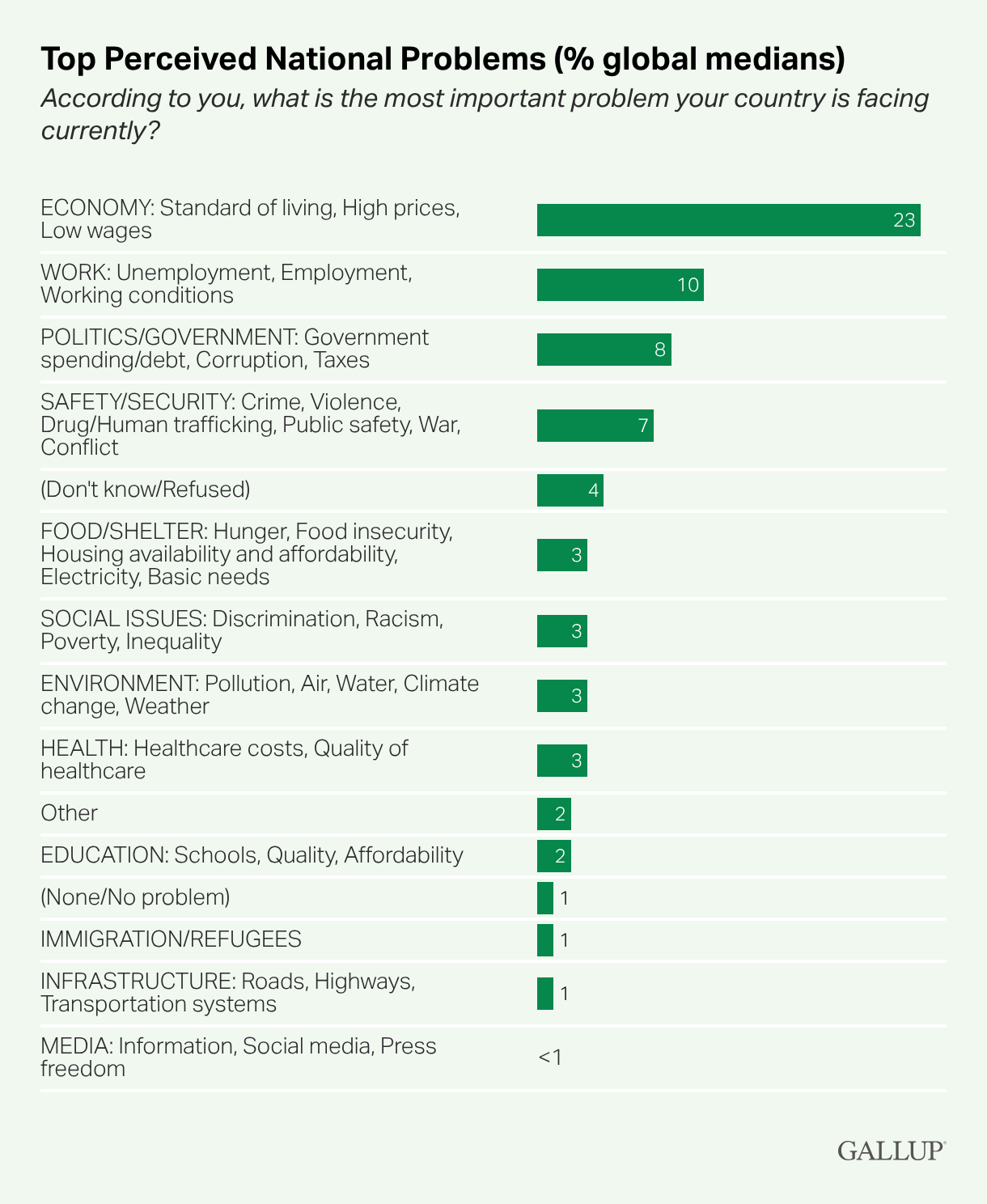
The deeper data reveals something most leaders miss entirely: engaged employees—those who are fulfilled, motivated, and thriving at work—are just as concerned about the state of work as disengaged employees. After controlling for demographics and national income, 9% of engaged employees cite work as their country’s top problem, compared to 8% of not engaged and actively disengaged employees.
Read that again. People who are currently experiencing good, meaningful work are just as worried about the work crisis as people who are miserable in their jobs.
This is the smoking gun that proves we’re dealing with a systems problem, not an individual one. It’s like doctors in excellent health looking at rising rates of preventable disease and saying, “Yes, healthcare is our biggest national problem”—not because they personally need care, but because they can see the system failing most people around them.
The employment data reveals something even more striking: 17% of unemployed people name work as the top national problem, which makes sense. But 10% of currently employed people name work as the top problem too—and so do 10% of people completely outside the workforce: retirees who’ve left, students not yet in it, caregivers focused on family. People who aren’t even looking for jobs are just as concerned about the state of work as people currently employed.
This isn’t about individual job searches or personal career setbacks. This is collective recognition that the entire system of work has deteriorated to the point where even people outside it can see the problem clearly.
The Machine That Runs on Burnout
According to Gallup’s State of the Global Workplace Report 2025: only 21% of employees worldwide are engaged at work. Another 62% are disengaged, and 17% are actively disengaged—miserable enough to be potentially destructive. That means 79% of the global workforce is either checked out or actively suffering in their jobs.
The economic cost of this disengagement: $9.6 trillion in lost productivity, equivalent to 9% of global GDP. We’re losing nearly 10% of the entire world’s economic output because of broken workplace systems. This isn’t the cost of people being “too relaxed” or “not hustling hard enough.” This is the cost of 79% of workers being so disengaged that they can barely function—because the system is designed to burn them out.
And here’s what makes it a system problem rather than millions of individual problems: the pattern repeats across every industry with eerie consistency.
In healthcare, residency programs structure 80+ hour weeks as “standard training,” then act surprised when doctors burn out making life-or-death decisions while sleep-deprived. In law, firms track billable hours that require 60+ hour weeks minimum, then wonder why associates leave after a few years. In finance, junior analysts expect all-nighters during “deal season” that somehow lasts year-round. In tech, “crunch time” becomes permanent at startups normalizing 80-hour weeks. In nonprofits, mission-driven workers sacrifice their own wellbeing “for the cause” until they have nothing left to give.
Every industry has its version of the burnout calendar. Every field has its ritual of introducing new workers to the idea that destruction of their wellbeing is simply “part of the job.”
And just like in teaching, every industry tracks the burnout, measures it, writes concerned articles about it—and keeps the system exactly the same.
What the System Gets Wrong
The current work system makes five fundamental assumptions about humans that are simply false:
First, it assumes consistent 8-hour productivity every day, regardless of energy levels, creative cycles, or natural human variation. But humans aren’t machines. We have days when we have high energy and focus and can work intensely for hours, and days when we’re depleted and need to recharge. Forcing consistent output regardless of input is how you break people.
Second, it measures hours worked instead of quality of output—time in seat rather than actual contribution. This incentivizes exactly the wrong behaviors: showing up exhausted, producing mediocre work, and eventually burning out completely. No machine can match human creativity, insight, or innovation, but only when humans are working in conditions that actually support those capacities.
Third, it punishes success with increased burden instead of increased support. Like Garrett winning Teacher of the Year and getting six different lesson plans with no additional help, the system identifies excellence and responds by extracting more until the person breaks. In healthcare, the best doctors get the most complex cases with no reduction in patient load. In law, top performers get more clients with the same billable hour requirements. In tech, high performers get more projects with the same deadlines. Success becomes its own punishment.
Fourth, it treats recovery time as weakness rather than necessity. Garrett discovered after leaving teaching that his creative work operates in natural cycles: high output days on Monday and Wednesday when he works longer with intense focus, recovery days on Thursday and Friday with lighter work or rest, flexible weekend work only when energy naturally pulls him back. Since adopting this rhythm, he sleeps better, stopped needing daily naps, eating healthier, less grumpy, and actually enjoys his work again. The difference wasn’t changing careers—it was working in a system that allowed him to work like a human instead of a machine.
Fifth, it normalizes burnout as inevitable instead of seeing it as a design flaw. Remember that burnout calendar on Garrett’s first day of teacher training? The county knew teachers were burning out. The administrators knew. The veteran teachers knew. They had the statistics showing most teachers quit within five years. Everyone knew the system was broken—and nobody changed it. They just kept hiring fresh, enthusiastic teachers and burning them out in turn, an endless cycle where individual solutions never fix the systemic problem because the problem is the system.
The Pattern in the Global Data
The Gallup research reveals three patterns that prove work is a systems problem operating at global scale.
First, GDP growth doesn’t predict work concerns at all. National economic growth shows no meaningful relationship to whether people view work as a top concern. Rich, growing economies still have profoundly broken work systems. This demolishes the argument that “economic success will eventually fix work problems.” Finland—one of the world’s happiest countries—saw work concerns spike to 17% as unemployment rose to 10.3%, the highest in over a decade. Even in prosperous, high-wellbeing countries, broken work systems can dominate national consciousness.
Second, subjective perception matters far more than objective metrics. People who report “living comfortably on their present household income” are much less likely to identify the economy as a top problem (correlation of -0.43), while actual GDP growth barely matters at all (correlation of 0.11). How people feel about their economic security shapes their priorities far more than the numbers on a page. This pattern holds for work too: objective employment statistics matter less than subjective experience of work quality. You can have low unemployment and still have a work crisis if the jobs available are low-quality, unstable, or unsustainable.
Third, the broken system hurts the most vulnerable most intensely. Economic and work concerns concentrate among young adults aged 15-34 (34% cite economy as top concern versus 30% of those 55+), women (35% versus 31% of men), and people classified as “suffering” in their overall wellbeing (36% versus 30% of those “thriving”). In high-income countries, the generational gap is particularly striking: in New Zealand, young adults are 24 percentage points more likely than the oldest residents to prioritize economic concerns, with similar gaps in the UK (+20), Canada (+20), the US (+19), and Australia (+17).
In wealthy nations, young people overwhelmingly feel the economy is failing them despite living in prosperous societies. This mirrors Garrett’s experience perfectly: he was in his twenties, high level of energy, with every traditional marker of success—Teacher of the Year, dream job, doing exactly what he loved—and completely miserable because the system itself was extracting more than he could sustainably give.
The people with power to change the system—executives, policymakers, established professionals—often have more control over their schedules and support structures. Those who could work differently often do. Those who can’t, burn out. This isn’t a meritocracy. This is a system that privileges those who entered it when it was less broken or who have accumulated enough power to opt out of its worst features, while grinding down everyone else.
When Individual Solutions Aren’t Enough
Here’s the most important point about why this is a systems problem: for every person like Garrett who escapes a broken system, the system immediately replaces them with someone new to burn out.
Garrett left teaching after six years. The system hired a fresh, enthusiastic teacher and started the burnout cycle over again. This happens in every field: burned-out doctor quits, medical school graduates new doctor into same system. Exhausted tech worker leaves, company hires eager new grad into same 80-hour culture. Depleted experienced nonprofit worker exits, organization recruits mission-driven replacement at lower pay and lower experience into same unrealistic workload.
The burnout factory keeps running.
Individual resilience, better time management, mindfulness practices, workplace wellness programs—these are valuable as coping mechanisms, but coping mechanisms don’t fix broken systems. You can’t meditate your way out of a system designed to extract unsustainable amounts of work. You can’t time-manage your way out of six different daily lesson plans with no support. You can’t be resilient enough to work 80-hour weeks indefinitely without breaking.
The county that trained Garrett knew teachers were burning out. They showed new teachers the calendar proving it. They had decades of data. And they changed nothing about the system that caused it—they just kept processing new teachers through the same meat grinder.
That’s what makes it systemic: not that individuals burn out, but that the system is designed to burn them out, predictably and repeatedly, and continues operating exactly the same way despite everyone involved knowing the human cost.
The Cost of Staying the Same
When Garrett finally sat down with his principal and said he wasn’t coming back, he had no plan. “It was really exciting and really scary,” he says now. “It was exactly what I needed.” That summer he kept himself busy—he’d recently completed his Masters in Nonfiction Writing at Johns Hopkins, and he started writing not because anyone was paying him but because it was the one part of teaching he actually missed. He wrote about masculinity, vulnerability, what it means to be a man in the 21st century. Eventually he started Dudefluencer, an online men’s magazine focused on vulnerability, introspection, and empathy—not the hustle-culture alpha-male grindset, but something different.
Today Garrett works as Content Manager at The Loop Marketing in Washington DC, creating content strategies for various companies, with Dudefluencer continuing as a passion project on the side. He works Monday and Wednesday intensely when his creative energy peaks, takes it easier Thursday and Friday, picks up hours on weekends when he feels the pull. He’s sleeping better. No more daily naps, no more Krispy Kreme ritual, no more McDonald’s emotional eating. His wife says he’s less grumpy. He talks about his work with excitement again.
Same person. Different system.
The transformation wasn’t about finding the perfect job or becoming an entrepreneur or “fixing” himself. It was about stopping work in a system designed to burn him out and building a life around flow instead—around the natural rhythms of intense creative output followed by necessary recovery, of writing mode and reading mode, of work that honors rather than ignores his humanity.
But multiply the opposite across the 79% of disengaged workers globally and you’re looking at hundreds of millions of people living in unnecessary misery and performing far below their potential because we’re maintaining systems that treat humans like machines. The current broken system costs $9.6 trillion annually in lost productivity—not from people being “too relaxed” or “not hustling hard enough,” but from 79% of workers being so disengaged that they can barely function in systems designed to break them.
We have proof that another way is possible. We have data showing the catastrophic cost of maintaining the status quo. We have evidence that the current system disproportionately harms the most vulnerable. We have every reason to change and no good reason to maintain broken systems designed for a world that no longer exists.
The question isn’t whether we can afford to redesign work around how humans actually function.
The question is whether we can afford not to.
Maybe it’s time to stop showing new teachers the burnout calendar and start redesigning the system so burnout isn’t inevitable in the first place. Maybe it’s time to stop measuring hours worked and start measuring quality of output. Maybe it’s time to stop punishing success with increased burden and start building support structures that scale with responsibility. Maybe it’s time to stop treating recovery as weakness and start valuing it as essential to sustained high performance.
Maybe it’s time to stop accepting that 79% of the global workforce is disengaged or actively miserable as “just how it is.”
Because Garrett’s story isn’t ultimately about one burned-out teacher who found a better way. It’s about what happens when we mistake a system problem for a personal failing—when we convince people like Garrett that they’re weak for not being able to handle a workload literally designed to be unsustainable, when we normalize the destruction of human wellbeing as “part of the job,” when we keep the burnout factory running because changing the system seems harder than just hiring new people to break.
The system was the problem. The system is still the problem. And until we stop normalizing burnout and start building systems that allow for flow—that recognize natural creative cycles, measure outcomes instead of hours, provide support that scales with responsibility, treat recovery as essential rather than optional—we’ll keep losing talented, passionate people like Garrett to a machine that grinds them down and spits them out.
$9.6 trillion says we can’t afford to wait any longer.
I’m working on the Unhustle book and would love your input on this post. Leave a comment below and join the advanced reader team.
Grateful for another person talking about burnout as a systemic issue. I talk about how it impacts fundraisers in the nonprofit sector over at the Nonprofit Culture Lab (after living it myself for decades).