

It all started a few years back.
The last few months of 2019 were a blur of Trump impeachment headlines, the movie Joker breaking box office records, Billie Eilish everywhere, TikTok blowing up, and Baby Yoda memes taking over the internet. I was 48, and for years I’d sensed something was fundamentally wrong with the way we live and work. I’d read over 600 books, watched hundreds of TED Talks, and yet, I couldn’t get an answer. One day, I finally admitted it: I was tired of the pressure to do more, run faster, keep hustling. My soul was calling bullshit on hustle culture. I wanted to opt out. But how?
I started digging. How did we get here? Why do we keep going like this? I knew I wasn’t the only one questioning the rat race and everything that comes with it: identity, meaning, the career ladder, security, never enoughness. Someone needed to write a manual of sorts for getting out.
As an overachiever, I dove into research. Pretty soon, I had more studies and notes than I knew what to do with. A solid argument began to emerge that there is, indeed, a different way. As a true marketer, I made up a word.
Unhustle.
It felt right, as it was exactly 180 degrees from the problem. Doing less leads to so much more: calm, clarity, connection, creativity, self-awareness, emotional intelliegnce, freedom, energy, excellence, impact. A different way to win in life and succeed at work appeared that didn’t require burning the midnight oil, staying stuck in a soul-sucking career, or equating self-worth with productivity. If we figure out how to do things differently, the future could be better for everyone. But back in 2019, I didn’t feel that optimistic. I felt our society was losing its grip on what was important.
“You should write a book,” said Ken, my neighbor, over a beer we had together at Alibi in Incline Village.
“Sure, why not?” I said, thinking I’d bang it out in eight months, maybe a year if I dragged my feet. A high achiever likes a challenge.
A few months later, the pandemic hit. The world slammed on the brakes. Suddenly, everyone was questioning the grind. People quit their jobs, baked sourdough bread, read books, spent time outside, started hobbies, and finally asked if all this addiction to work was worth the expense of their well-being, mental health, and real living. The unhustling message started popping up everywhere—on LinkedIn, Instagram, and TikTok. It felt like a movement. Millions of coaches appeared overnight with modalities and frameworks, therapists launched Instagram accounts that attracted millions, and neuroscientists wrote books about it. For a second, I thought somebody had done my work here already, and I could finally relax.
The pandemic ended. But the problems didn’t go away; they got worse. With return-to-the-office mandates came more discontent, burnout, and disengagement. Life moved even faster. And then, AI showed up. We are now entering the Acceleration Decade, and things are only speeding up.
So, I kept writing. I kept researching, interviewing, piling up evidence and more material. I thought I was losing my mind. Outlines on top of outlines, subfolders inside folders. Research scattered in Evernote, Notes, Readwise, Notion, Google Drive. Not to mention the countless journals stacked around my desk and sticky notes of the book’s structure on the wall.
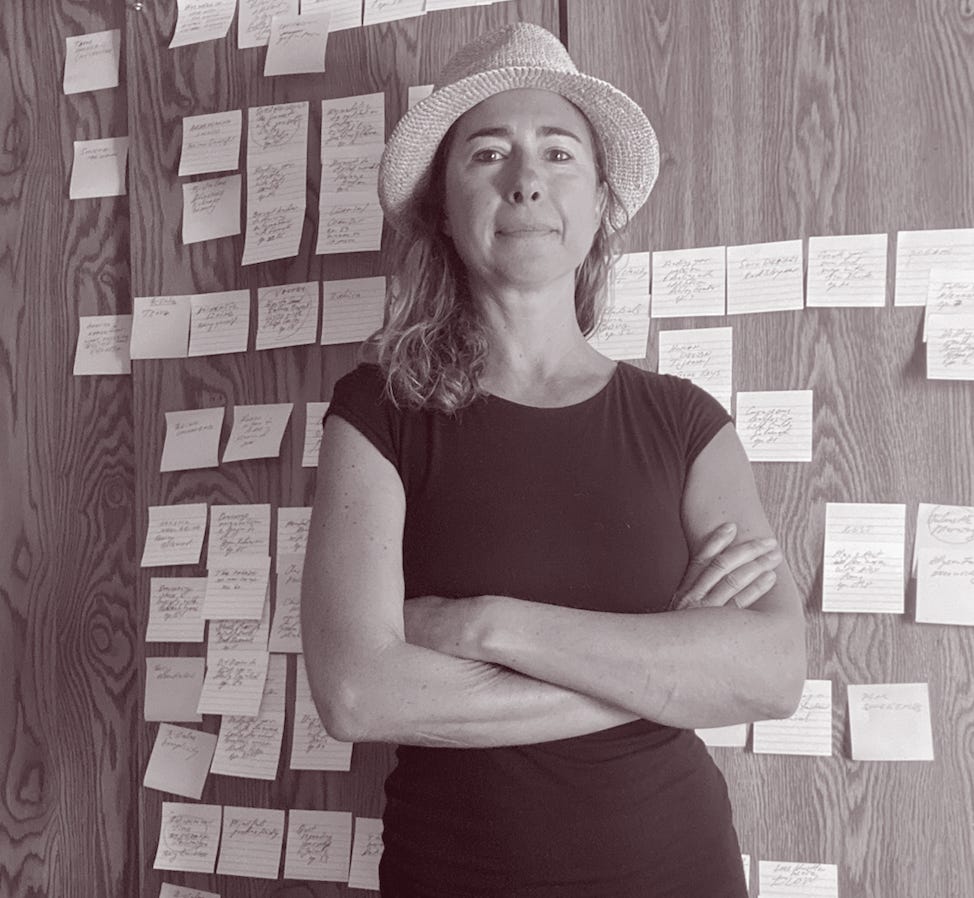
I’ve written this book at least ten times. And I have wanted to toss my laptop in the ocean more times than ten. At one point, it was 160,000 words. I’ve cut it more than half. V1, V2, all the way to V8, then folders called FINAL and folders by year.
Maybe I’m a perfectionist. Maybe creative projects take as long as they take. Maybe I had to face my own conditioning and limiting beliefs and live what I’m actually preaching. Along the way, there were plenty of failed experiments. A few wins. Tequila. Sobriety. Hours of ocean therapy. I refused to write about something I hadn’t personally experienced. This book has changed with the times, and with me. I have changed because of it. I haven’t perfected anything, but these days I know when I start to veer off course and can course-correct sooner. I still step in shit. I just scrape it off my shoes with a smile, call it good luck, and keep going.
Unhustling is a skill, wisdom, and rebellion in a world that won’t slow down. A superpower in a world addicted to busyness. Highly underrated. Extremely valuable.
I learned writing a book is not just time-consuming, but also expensive. Feeling the pressure to make money to support myself and pay for editors, cover design, and interior formatting, I launched various programs, retreats, communities, and speaking engagements. Most were successful, but I couldn’t do them all at once. I learned to practice what I preach. I promised Phil six months to recoup my income from my previous career, and we’re going on six (or maybe seven) years. (More on this in the next post. I’m thinking of launching something that may resonate with you on how to build a platform, a business, a book, but not with the typical hustle mode. A few of us will team up to build our own things, without burning out. DM me if this resonates.)
At some point, I wondered whether anyone even cared about the evidence or just wanted a quick fix from hustle culture. The quick fix, by the way, is realizing there isn’t one—the behavior took years to build, the conditioning runs deep, and the way out is a skill and a practice, not a hack. The last thing I wanted was another cookie-cutter self-help book. I’d rather make you think, share real stories from real people, and show you it’s possible. Humans learn from stories, not from some 30-day template the self-help industry tries to sell you. The book took years to write because transformation takes time.
People kept asking, “How’s the book?” I’d say, “Getting close.” But close isn’t done. He thought I’d lost it. I thought so too. Some folks thought I’d already published it and congratulated me.
Meanwhile, I watched other authors crank out book after book every two years. My ego took a hit. But I knew this book mattered, so at some point I did what needed to be done. I dropped everything else to finish it. I slowed down, on purpose. The sunk cost fallacy is real, and my costs were too high to quit.
Somewhere in the middle, we moved countries. Moving to the beach would give me the space to finish the book. More time went by. I spent more time on the ocean. I promised myself I’d finish it because I knew in my heart it could help someone else, even if it meant living on tacos. Two more years went by. I heard someone say, “It’s not about the ink; it’s about the think.” I enjoyed the think. It has been meditative and healing. That part about writing a book is actually good. I will miss that focused time where you get lost in flow and the day shrinks to minutes.
I’ve lived in three countries, put myself through an MBA while juggling eight jobs, and changed careers in my forties. Writing this book is the hardest thing I’ve ever done, and I’m fairly certain I never want to do it again.
I decided to go the indie publishing route with this book even though I’ve had a great opportunity to pursue traditional publishing. While it comes with certain advantages, it also has rules and deadlines I didn’t want to follow. I can’t abide by some old-world book-publishing rules and a launch template for a book called Unhustle that sounds like hustle. It will live or die based on what you think. The research will keep growing. More stories will show up.
During the editing process, Pages on my computer crashed more than once. I almost lost the entire thing. It was a message from the Universe. It was time to let it go. I wanted to give up, but I pulled an old Mac instead, dusted it off, and kept going. I knew then that perhaps I’ve learned something along the unhustle journey.
This book is my best shot at explaining why we fall for hustle culture, why we get stuck on the default path, and how unhustling helps you find another way. How you can create your desire path. The term desire path comes from urban planning and you’ve seen it already - it’s the grass cut in the park where enough people decide that following the default path doesn’t take them to where they want to go the best way possible. Creating your desire path takes time. Patience. And a lot of love. The goal is to enjoy the journey, have fun, keep an open mind, and trust your intuition and your heart. I’ve lived this book for the past ten years, and I can say with zero doubt: there’s no better time than now for it.
Your life. Your rules.
I’m proud of the final product, and I can’t wait to hear what you think. When I sent the VERY rough draft to a few early readers, the feedback was mostly good.
“FINALLY!!! You’ve seen through the lie. This is the kind of liberation I’ve been working for, personally and professionally, for 50+ years,” said one of them. “In many ways, it was like being punched in the gut in the best possible way,” said another. People tell me they cry, they rethink how they live and work, they change. That’s all I could ever ask for.
So that’s the story.
Join the Advance Reader Team and read it before it's published.
UNHUSTLE
A Rebel’s Guide to Escaping the Grind
and Building Life Wealth
COMING THIS MARCH 2027
Foreword by Chip Conley
I'm building a small team of 100 advance readers who'll get the book 4-6 weeks before launch—in exchange for one thing: an honest review on release day so that more people can find it. Not a positive one. An honest one. If you're in, tell me a bit about yourself below.
Thank you for being part of a team for a book built on a shoestring budget, a ton of passion, and an idea that kept me up at night for years, and one I hope makes the world a tiny bit better.
Milena

We do care, Milena. It's a journey and the most difficult one is always the most rewarding one. Keep going and sharing your passion for helping people see the light.
Thanks for the food for thought today ✍️ ✨❤️